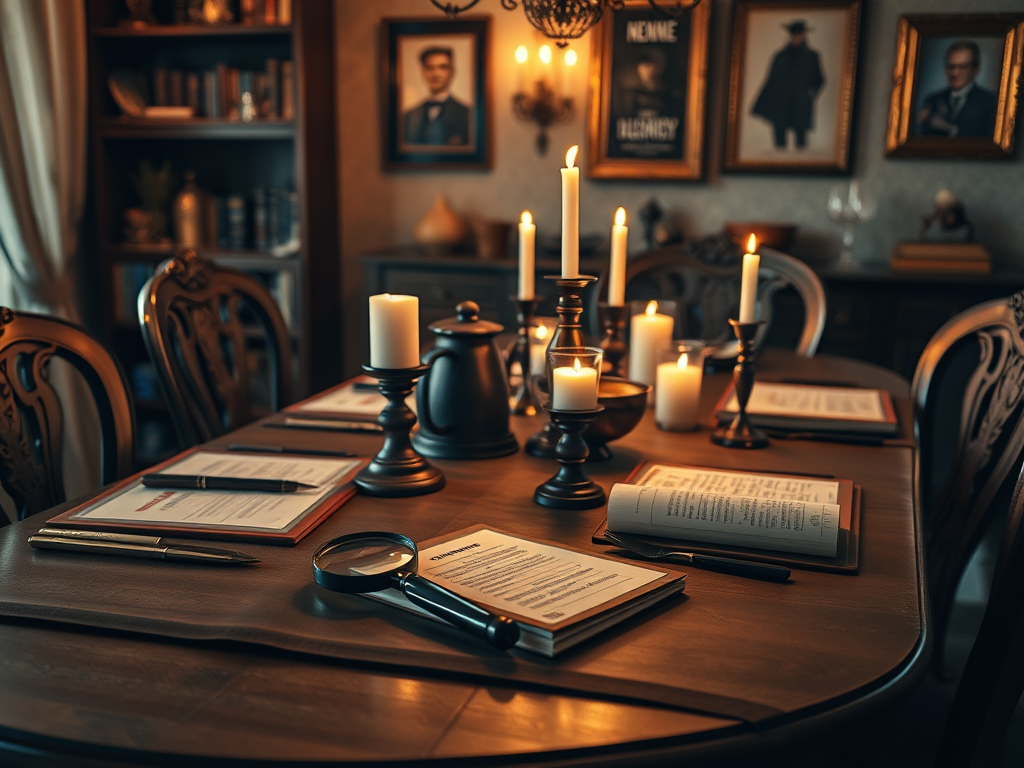
From classic Cluedo to sophisticated case files, mystery games come in many formats. Here’s an honest comparison to help you choose the detective experience that matches your playing style.
Reading time: 9 minutes
Last updated: December 2025
The mystery game market has exploded. What once meant “Cluedo at Christmas” now encompasses everything from elaborate boxed detective games to digital investigations to printable case files you download and play within minutes.
With so many options, choosing the right format can feel overwhelming. Board game mysteries, print-at-home case files, boxed detective sets, and digital platforms all promise immersive investigative experiences. But they deliver fundamentally different things.
This guide breaks down each format honestly—the strengths, the limitations, and the players each serves best. By the end, you’ll know exactly which type of mystery game deserves your time and money.
The Major Mystery Game Formats
Classic Board Game Mysteries
Think Cluedo (Clue in North America), Mystery of the Abbey, or Chronicles of Crime. These games use boards, cards, dice, and structured mechanics to create deductive experiences.
How they work: Players move pieces, draw cards, make accusations, and use game mechanics to narrow down possibilities. The mystery emerges through gameplay systems rather than narrative evidence.
Session length: 45-90 minutes typically
Player count: Usually 3-6 players
Modern Boxed Detective Games
Products like Detective: A Modern Crime Board Game, Sherlock Holmes Consulting Detective, or the Unsolved Case Files series. These emphasise narrative and evidence over traditional board game mechanics.
How they work: Players receive case materials, examine evidence documents, read narratives, and piece together solutions. Less “game” in the traditional sense, more collaborative investigation.
Session length: 2-4 hours
Player count: 1-4 players typically
Print-at-Home Mystery Case Files
Downloadable mystery games you print yourself. You receive PDF files containing evidence documents, photographs, witness statements, and other materials that you print and play immediately.
How they work: Similar to boxed detective games but delivered digitally. Evidence arrives in phases, players investigate collaboratively, and solutions are revealed at the end.
Session length: 2-4 hours
Player count: 1-4 players typically
Digital/Online Mysteries
Browser-based or app-based investigations where you access virtual case files, watch video evidence, and interact with multimedia elements.
How they work: You navigate digital interfaces simulating police databases, review video clips, examine photographs, and submit theories online.
Session length: 2-6 hours
Player count: 1-4 players typically
Format Comparison: The Honest Assessment
Classic Board Game Mysteries
Strengths:
- Highly replayable. Random elements mean each game plays differently. You can enjoy Cluedo dozens of times.
- Family-friendly. Simple rules make these accessible to younger players and mixed-age groups.
- Social dynamics. The competitive element creates table talk, bluffing, and interaction.
- Shorter sessions. Easy to fit into a casual game night.
- Low commitment. If someone’s not enjoying themselves, the game ends relatively quickly.
Limitations:
- Limited immersion. Game mechanics dominate the experience. You’re playing a deduction game, not solving an actual mystery.
- Thin narrative. Characters and settings serve the game system rather than the story.
- Predictable formats. After you understand the mechanics, the experience becomes routine.
- Solution can feel arbitrary. The killer is randomly assigned rather than following from clues.
Best for: Family game nights, casual social gatherings, players who prefer light entertainment over deep engagement.
Modern Boxed Detective Games
Strengths:
- Deep immersion. High-quality materials create genuine investigative experiences.
- Substantial narrative. Real stories with complex characters and meaningful motives.
- Premium presentation. Physical evidence, sealed envelopes, quality printing, and sometimes props.
- Gift-worthy. Beautiful packaging makes these excellent presents.
- Satisfying length. Enough content to fill an evening.
Limitations:
- Cost. Quality boxed sets run £20-40 or more. For a one-time experience, that’s significant.
- Storage and waste. Once solved, the box sits on your shelf. Materials can’t be reused by you.
- Shipping delays. You wait for delivery rather than playing immediately.
- Quality varies wildly. Some boxed games have excellent production but weak mysteries. Research before purchasing.
- Not replayable. Once you know the solution, the game is finished.
Best for: Special occasions, gift-giving, collectors who appreciate physical products, players who don’t mind paying premium prices for polished experiences.
Print-at-Home Mystery Case Files
Strengths:
- Immediate access. Purchase, download, print, and play within an hour. No waiting for shipping.
- Affordable. Typically £8-20 for a complete investigation. Multiple mysteries for the price of one boxed set.
- Tactile experience. Physical documents to handle, mark up, and arrange spatially—without premium pricing.
- Low waste. Print exactly what you need on recycled paper if you choose.
- Pass-along friendly. After playing, give printed materials to friends who haven’t solved the case.
- Flexible difficulty range. Publishers can offer varied complexity since they’re not targeting retail shelf appeal.
Limitations:
- Requires printing. You need access to a printer (colour preferred for best experience).
- DIY presentation. Materials won’t match the production polish of premium boxed sets.
- Digital discovery required. You need to find and evaluate publishers online rather than browsing shop shelves.
- Variable quality. The low barrier to entry means some print-at-home games are poorly designed.
- Not replayable. Same as boxed games—once solved, you know the answer.
Best for: Budget-conscious players, those who want frequent mystery experiences, couples and small groups, players who enjoy the tactile feel of physical evidence.
Digital/Online Mysteries
Strengths:
- Multimedia evidence. Video clips, audio recordings, and interactive elements impossible in print formats.
- Zero preparation. No printing, no setup—just open a browser and play.
- Continuous updates. Platforms can add new cases regularly.
- Accessible anywhere. Play on laptop, tablet, or phone.
- Advanced production. High-end platforms feature sophisticated interfaces and extensive content.
Limitations:
- Screen fatigue. If you’re looking to escape screens, this isn’t it.
- Less tactile. You can’t physically arrange evidence, circle details, or write in margins.
- Platform dependency. If the service shuts down, your purchases may disappear.
- Distraction-prone. Notifications, messages, and the temptation to tab away compete for attention.
- Variable quality. Some digital platforms feel more like click-through stories than genuine investigations.
Best for: Tech-comfortable players, those who want multimedia immersion, solo players who prefer screen-based entertainment, people without printer access.
Decision Framework: Finding Your Format
Answer these questions to identify your ideal mystery game format.
How important is physical interaction with evidence?
Very important → Print-at-Home or Boxed Games. If you want to touch documents, arrange papers spatially, and circle clues with a pen, you need physical formats.
Not important → Digital Mysteries. If screens don’t bother you and you value convenience, digital works fine.
What’s your budget for mystery games?
Limited budget → Print-at-Home Mystery Case Files. You’ll get 3-4 mysteries for the cost of one premium boxed set.
Generous budget → Boxed Games. If money isn’t the primary concern, premium products deliver premium experiences.
Somewhere between → Mix both. Buy one nice boxed game for special occasions, print-at-home games for regular play.
How often do you want to play mystery games?
Occasionally (a few times per year) → Boxed Games. The higher cost per play is acceptable for infrequent sessions.
Regularly (monthly or more) → Print-at-Home. The cost advantage compounds quickly with frequent play.
Who are you playing with?
Family with kids → Classic Board Games. The structured mechanics and shorter sessions suit mixed ages.
Partner or small adult group → Print-at-Home or Boxed. The deep investigation formats shine with 1-4 engaged players.
Large groups → Classic Board Games or Murder Mystery Dinner Party formats (a different category entirely).
How much time do you want to invest?
Under 90 minutes → Classic Board Games. Quick to play, quick to finish.
2-4 hours → Print-at-Home or Boxed. The substantial investigation experience.
Variable/Ongoing → Digital Platforms. Some offer episodic content you return to over days or weeks.
The Print-at-Home Mystery Case Sweet Spot
For players who want frequent, immersive, affordable mystery experiences, print-at-home case files hit an exceptional value proposition.
Consider the maths: A quality boxed detective game costs £25-40. A print-at-home mystery costs £10-18. For a year of monthly mystery nights, you’d spend £300-480 on boxed games versus £120-216 on print-at-home files. That’s £200+ saved annually—or four times as many mysteries for the same budget.
The experience quality is comparable. Both formats deliver evidence-based investigation with complex narratives. The main difference is packaging, and frankly, elegant packaging matters less once you’re absorbed in solving a case.
Print-at-home also offers something boxed games can’t: immediate gratification. Decide tonight you want a mystery? You can be playing within an hour. No waiting for delivery, no hoping the shop has stock.
Quality Indicators: What to Look For
Regardless of format, certain markers distinguish excellent mysteries from disappointing ones.
Look For:
- Detailed evidence documents. Quality mysteries feature substantial materials, not single-page summaries.
- Complex, interconnected characters. Suspects with genuine depth and believable motives.
- Fair play construction. All clues needed to solve the mystery are provided to players.
- Graduated difficulty. Clear indication of how challenging the mystery is.
- Hint systems. Options for help if players get stuck.
- Satisfying solutions. The answer should feel earned, not arbitrary.
Avoid:
- Vague evidence. If documents feel thin or rushed, the mystery probably is too.
- Random solutions. If the killer could be anyone regardless of clues, the design is lazy.
- No difficulty rating. Publishers confident in their product clearly indicate challenge level.
- Excessive complexity without purpose. More evidence doesn’t mean better mystery.
Making Your Choice
There’s no universally “best” mystery game format—only the best format for your specific situation.
Choose Classic Board Games if you’re playing with family, want competitive dynamics, or prefer shorter sessions with high replayability.
Choose Modern Boxed Games if you’re buying a gift, marking a special occasion, or value premium physical presentation above all else.
Choose Print-at-Home if you want frequent mystery experiences at reasonable cost, appreciate tactile evidence handling, and don’t need retail packaging.
Choose Digital if you prefer screen-based entertainment, want multimedia evidence, or need zero-preparation convenience.
Most dedicated mystery fans eventually try all formats. Each has genuine merits. The key is matching the format to your current needs rather than assuming more expensive always means better.
Ready to try print-at-home mystery games? Browse our collection of detective cases designed for small groups and solo investigators.
Related Articles: