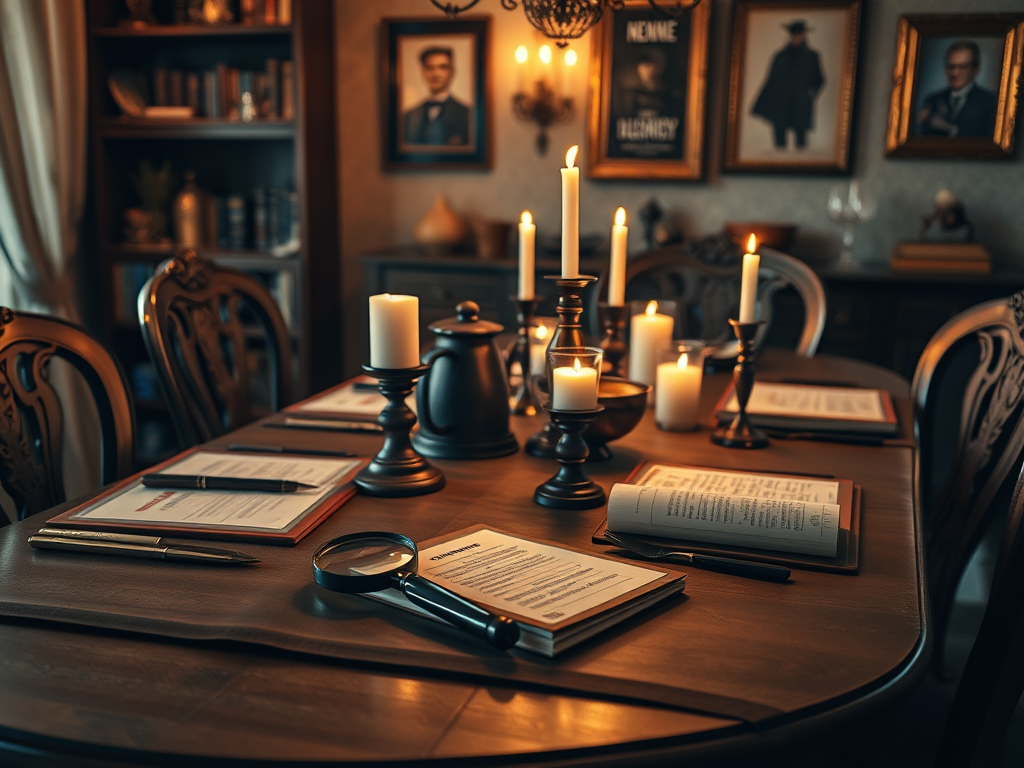
Everything you need to create an unforgettable detective experience—from choosing your case to setting the atmosphere to ensuring everyone has a brilliant time.
Reading time: 10 minutes
Last updated: January 2026
You’ve decided to host a mystery night. Whether it’s for date night, a small gathering of friends, or a family activity, you want the evening to feel special—not just “playing a game” but creating a genuine experience.
Good news: with the right preparation, hosting a mystery night at home is easier than you think. This guide covers everything from selecting your case to creating atmosphere to managing the investigation itself. By the end, you’ll have a complete blueprint for a memorable evening.
Choosing Your Mystery
The case you select shapes the entire evening. Choose wisely.
Match Difficulty to Your Group
This is the most important decision you’ll make. Get it wrong, and the evening suffers.
For first-time mystery players: Choose “Easy” or “Beginner” rated cases. The goal is success and enjoyment, not frustration. Players can always tackle harder mysteries later—but a discouraging first experience might mean there is no “later.”
For experienced puzzle enthusiasts: Look for “Medium” to “Hard” rated cases. These players will be bored by obvious solutions and appreciate genuine challenge.
For mixed groups: When some participants are seasoned and others are new, err toward easier. It’s better for experienced players to feel clever than for newcomers to feel lost.
Consider Your Time Frame
Mystery games vary significantly in length. Make sure your choice fits your available time.
Short evening (2-3 hours): Smaller scope mysteries with fewer suspects and streamlined evidence. Perfect for weeknight gatherings.
Full evening (3-4 hours): Substantial investigations with multiple phases and complex character webs. Better for weekends when time isn’t pressing.
Extended sessions (4+ hours): Complex, multi-layered cases for dedicated mystery enthusiasts. Consider splitting across multiple sessions.
Match Theme to Audience
The setting matters. Players engage more deeply with themes that resonate.
Classic whodunits: Elegant manor houses, dinner party murders, Agatha Christie-style mysteries. Sophisticated, timeless appeal.
True crime style: Contemporary settings, realistic police procedures, forensic evidence. Perfect for podcast fans and crime documentary enthusiasts.
Historical mysteries: Victorian London, 1920s speakeasies, wartime intrigue. Great for history buffs and those who enjoy period atmosphere.
Holiday themes: Christmas capers, Halloween mysteries, seasonal cases. Excellent for festive gatherings and annual traditions.
Check Content Appropriateness
Most mystery games involve fictional crimes, often murders. This is generally fine for adult entertainment, but consider your guests.
- Are any participants uncomfortable with violent themes?
- Are children involved? (Many mysteries offer family-friendly versions.)
- Does anyone have trauma around specific topics?
A quick content check prevents awkward surprises mid-investigation.
Preparing Your Space
The environment shapes the experience. A bit of preparation transforms “playing a game” into “investigating a case.”
Clear Your Investigation Area
You need space to spread documents, examine evidence, and take notes. Options include:
Dining table: The classic choice. Large surface, everyone seated comfortably, good lighting.
Coffee table setup: More casual. Works well for couples or small groups who prefer cosy seating.
Floor space: For larger evidence layouts. Less formal but allows spreading materials extensively.
Whatever you choose, clear it completely. You want uninterrupted surface area for your investigation.
Gather Your Supplies
Before guests arrive, assemble everything you’ll need:
Essential:
- Printed mystery materials (if using print-at-home format)
- Pens or pencils for everyone
- Notepaper for observations and theories
- Good reading light
Helpful:
- Highlighters for marking key details
- Post-it notes for flagging important documents
- A whiteboard or large paper for timeline building
- Scissors (some games include elements to cut out)
For atmosphere:
- Candles or dim lighting
- Background music appropriate to the mystery’s setting
- Thematic refreshments (more on this below)
Check Your Printing (For Print-at-Home Games)
If you’re using print-at-home case files, prepare materials in advance. Rushing through printing as guests arrive creates stress nobody needs.
- Print all documents at least an hour before the event
- Check print quality—especially photographs and detailed evidence
- Organise materials into phases if the game is structured that way
- Keep solution and hint sections separate to avoid spoilers
Creating Atmosphere
The difference between “good” and “unforgettable” often comes down to atmosphere.
Lighting
Bright overhead lights feel like an office. Dim the main lights and use:
- Table lamps positioned for reading
- Candles (safely placed away from papers)
- String lights for ambient glow
The goal is readable but moody—you’re detectives piecing together clues, not accountants reviewing spreadsheets.
Music
Background music enhances immersion without distracting. Match it to your mystery’s setting:
1920s mysteries: Jazz, swing, speakeasy era recordings Victorian/Edwardian: Classical piano, orchestral pieces Contemporary cases: Subtle ambient soundscapes, film noir soundtracks Holiday themes: Seasonal music that matches the tone
Keep volume low—this is atmosphere, not the main event. Conversation should remain effortless.
Refreshments
Themed refreshments elevate the experience:
Classic mysteries: Wine and cheese, finger sandwiches, elegant appetisers 1920s settings: Cocktails (or mocktails), canapés Contemporary cases: Coffee, casual snacks—whatever feels natural Winter/holiday mysteries: Mulled wine, festive treats
Avoid complicated food requiring attention. Simple, pre-prepared options let everyone focus on the investigation.
Costumes (Optional)
Some groups love dressing up. Others find it silly. Know your audience.
If costumes appeal, keep expectations reasonable. “Smart casual inspired by the 1920s” is more achievable than “full period costume.” The goal is fun atmosphere, not pressure.
Running the Evening
With preparation complete, here’s how to manage the actual event.
The Opening (15-20 minutes)
Set the stage properly. This isn’t just “reading the instructions”—it’s establishing the experience.
- Welcome your detectives. Set the tone: “Tonight, you’re not just guests—you’re investigators on a case.”
- Present the premise. Read aloud (or have printed) the initial case setup. The crime, the circumstances, the mystery to solve.
- Explain the structure. How will evidence be revealed? What are the phases? When will they make their accusation?
- Distribute materials. Hand out initial evidence, notebooks, and pens.
- Answer questions. Clarify anything about how the game works before diving in.
The Investigation (2-3 hours)
Once begun, your role shifts from host to facilitator (if playing) or gentle guide (if running the game for others).
If you’re playing along:
- Resist the urge to dominate. Let others discover things too.
- Voice observations but welcome disagreement.
- Keep the atmosphere collaborative, not competitive.
If you’re facilitating for others:
- Release evidence according to the game’s structure.
- Monitor engagement—if people seem stuck, hint systems exist for a reason.
- Keep things moving if discussions stall.
- Ensure quieter participants have space to contribute.
For everyone:
- Take breaks as needed. Get up, stretch, refresh drinks.
- Encourage physical organisation of evidence—timelines, suspect lists, document groupings.
- Enjoy the debate. Disagreement about suspects is half the fun.
The Accusation (15-20 minutes)
Before revealing the solution, players commit to their theory:
- Who committed the crime?
- How did they do it?
- Why did they do it?
This moment matters. It’s the culmination of all that investigation. Give it weight.
Some groups discuss and reach consensus. Others allow individual accusations. Both approaches work—choose what suits your group.
The Reveal
Now the truth emerges. Read the solution aloud together, tracking how the evidence connected to the answer.
This is surprisingly satisfying regardless of whether you got it right. Solving the mystery feels triumphant. Getting it wrong but understanding why feels illuminating. Either way, the puzzle is complete.
The Debrief
Don’t rush away immediately. Some of the best conversation happens after the solution is revealed:
- What clues did you catch? What did you miss?
- When did your theory form? When did it change?
- Which suspect seemed most suspicious and why?
- What red herrings fooled you?
This discussion extends the experience and cements the memory.
Troubleshooting Common Issues
Even well-planned mystery nights can encounter challenges. Here’s how to handle them.
One Person Is Dominating
Some participants naturally take charge. This can frustrate others.
Solutions:
- Directly invite quieter participants: “What do you think about this evidence?”
- Assign roles: “You focus on alibis, you focus on motive.”
- Establish turn-taking for reading documents aloud.
The Group Is Completely Stuck
Stalling is frustrating. Use hint systems liberally rather than letting the evening stall.
Solutions:
- Suggest reviewing earlier evidence with fresh eyes.
- Use the game’s hint system—that’s what it’s for.
- As facilitator, offer gentle direction: “Have you noticed the timestamp on this document?”
Someone Isn’t Enjoying Themselves
Not everyone loves puzzles. If someone is visibly disengaged:
Solutions:
- Give them a specific role that suits their interest.
- Take a break—sometimes people just need a breather.
- Accept that mystery games aren’t for everyone. Don’t force it.
The Evening Is Running Long
If time becomes an issue:
Solutions:
- Skip to later evidence phases if necessary.
- Use more hints to accelerate progress.
- Save remaining investigation for another session if practical.
Someone Accidentally Sees a Spoiler
If a player glimpses the solution:
Solutions:
- That player can become a facilitator, helping guide others without solving.
- If everyone’s investment is broken, call it and try a different game another time.
- Laugh it off—these things happen. Games should be fun, not precious.
After the Mystery Night
The experience doesn’t have to end when the case is solved.
Capture the Memory
Take photos of your investigation setup—evidence spread across the table, your handwritten notes and theories. These become lovely memories of shared time together.
Plan the Next One
If the evening was a success (and it probably was), discuss when to do it again. Regular mystery nights become cherished traditions for many groups.
Share Your Experience
Did you enjoy a particular mystery game? Leave a review. Tell friends. Your feedback helps others find good experiences and helps publishers understand what works.
Pass It Along
If you used a print-at-home game, consider passing your printed materials to friends who haven’t played. The case extends its value when others enjoy it too.
The Payoff
A well-hosted mystery night delivers something rare: focused, engaged, shared experience. No screens. No distractions. Just people solving a puzzle together, testing their wits, debating theories, and feeling clever when things click.
In our fragmented, attention-scattered world, that kind of concentrated togetherness is precious. Mystery nights create memories that last far longer than the evening itself.
So gather your detectives. Set the scene. And remember: the game is afoot.
Ready to host your first mystery night? Browse our collection of print-at-home detective cases designed for small groups and couples.
Related Articles: