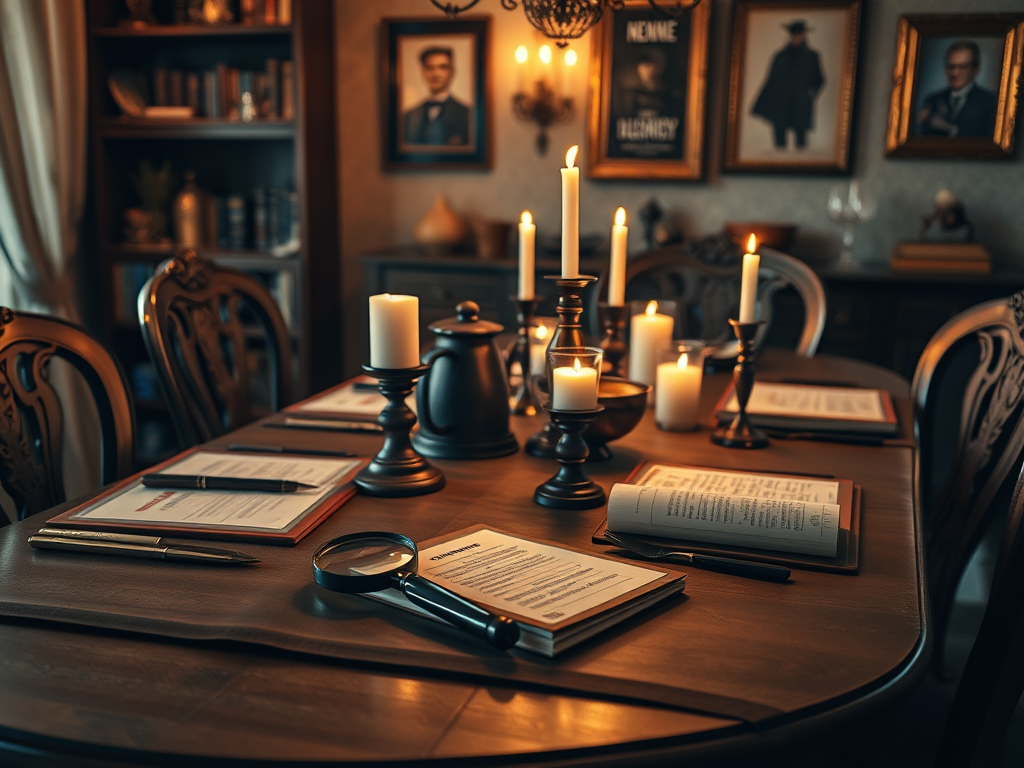
Discover the best mystery games for solo players—no party required. From printable case files to cold case investigations, here’s everything you need to know about playing detective on your own.
Reading time: 8 minutes
Last updated: December 2024
Think you need a group of friends to enjoy a good mystery? Think again. Solo detective games have exploded in popularity, offering true crime enthusiasts and puzzle lovers an immersive investigative experience from the comfort of their couch. Whether you’re curled up on a rainy afternoon or looking for a screen-free evening activity, mystery games for one player deliver the same thrill of cracking a case—without coordinating everyone’s schedules.
Why Solo Mystery Games Are Having a Moment
The rise of true crime podcasts and documentary series has created an entirely new audience hungry for interactive detective experiences. But here’s the thing: most murder mystery games were traditionally designed for groups. They required dinner parties, assigned roles, and enough friends willing to dress up and stay in character for hours.
Solo detective games changed everything.
These aren’t dumbed-down versions of party games—they’re sophisticated investigations designed specifically for individual players (or small teams who want to work together cooperatively). You’re not playing a character with scripted lines. You are the detective, analysing evidence, spotting contradictions in witness statements, and building your case piece by piece.
The appeal is obvious: complete immersion without the social logistics. No waiting for your turn. No dominating personalities steering the investigation. Just you, the evidence, and your deductive instincts.
Types of Solo Mystery Games
Not all detective games are created equal. Understanding the different formats helps you find the perfect match for your playing style.
Printable Case Files
Print-at-home mystery games deliver a physical, tactile investigation experience. You receive evidence documents, witness statements, photographs, and clues that you print and spread across your table. There’s something deeply satisfying about physically handling evidence—circling suspicious details, arranging documents in chronological order, and scribbling notes in the margins.
Best for: Players who want an offline, screen-free experience with authentic-feeling evidence materials.
Typical duration: 2-4 hours
What’s included: Police reports, witness transcripts, crime scene photographs, letters, receipts, newspaper clippings, and other documentary evidence.
Digital Case Files
Online mystery platforms offer browser-based investigations where you access a simulated police database, review CCTV footage, and examine multimedia evidence. These tend to feature more elaborate production values—actual video clips, audio recordings, and interactive elements.
Best for: Tech-savvy players who enjoy multimedia storytelling and don’t mind screen time.
Typical duration: 2-6 hours
Boxed Case File Games
Physical boxed sets contain pre-printed evidence packets, photographs, and sometimes props like sealed envelopes you open as the investigation progresses. These offer premium presentation but can’t be replayed since you’ll know the solution.
Best for: Gift-giving or collectors who appreciate high production values.
Typical duration: 2-4 hours
Escape Room Hybrids
Some mystery games blend detective investigation with escape-room-style puzzles. You’re solving a mystery, but you’re also decoding ciphers, finding hidden messages, and manipulating clues to reveal secrets.
Best for: Puzzle enthusiasts who want mental challenges beyond pure deduction.
Typical duration: 1-3 hours
What Makes a Great Solo Detective Game?
After years of playing and designing mystery games, certain elements separate the exceptional from the mediocre.
Realistic Evidence
The best solo mysteries feature evidence that feels authentic. Genuine-looking police reports. Witness statements that read like actual transcripts. Period-appropriate newspaper clippings for historical settings. When documents feel real, immersion follows naturally.
Complex Characters
One-dimensional suspects with obvious motives make for boring mysteries. Great detective games feature characters with psychological depth—people whose secrets interconnect in meaningful ways. Every suspect should be believable as the culprit until you find the evidence that proves otherwise.
Fair Play
This is crucial: all the clues needed to solve the mystery should be available to the player. Nothing frustrates more than a solution that relies on information you never received. The satisfaction comes from realising you had the answer all along—you just needed to see the connections.
Graduated Difficulty
The best mysteries escalate in complexity. Early phases establish the facts of the case. Middle phases introduce contradictions and complications. The final phase delivers the breakthrough evidence that makes everything click. This structure keeps players engaged without overwhelming them.
Hint Systems
Even the sharpest detectives get stuck sometimes. A well-designed hint system provides graduated assistance—from gentle nudges that point you in the right direction to more explicit guidance for genuinely stuck moments. The best systems let players choose their help level without revealing spoilers.
How to Choose Your First Solo Mystery Game
Ready to try your hand at detective work? Here’s how to pick a game that matches your preferences.
Consider Your Difficulty Tolerance
If you’re new to detective games, start with an “Easy” or “Beginner” rated case. These typically feature fewer suspects, more straightforward evidence, and clearer connections between clues. There’s no shame in building your skills before tackling complex investigations.
Experienced puzzle solvers might find easy cases too obvious. Look for games rated “Hard” or “Expert” that require synthesising information across multiple evidence types and catching subtle contradictions.
Think About Time Commitment
Some mysteries wrap up in 90 minutes. Others unfold across multiple sessions over several days. Be realistic about your available time. A complex case you abandon halfway through is less satisfying than a shorter mystery you complete.
Match the Theme to Your Interests
Mystery games span every conceivable setting and era. Victorian London murders. 1920s speakeasy intrigue. Contemporary true-crime investigations. Holiday-themed capers. You’ll engage more deeply with themes that genuinely interest you.
Check the Evidence Format
Do you want papers spread across your dining table, or do you prefer clicking through a digital interface? Both approaches have merits, but know your preference before buying.
Tips for Solo Detective Success
Create Your Investigation Space
Clear a table where you can spread evidence without needing to pack up. Good lighting matters—you’ll be scrutinising details. Have a notebook ready for your observations and theories.
Read Everything Carefully
Skim-reading is the enemy of good detective work. Evidence documents contain details that seem mundane but prove crucial. The exact time on a receipt. A throwaway comment in a witness statement. The address on a letter. These specifics solve cases.
Build a Timeline
Most mysteries revolve around opportunity—who was where, when. Constructing a timeline often reveals contradictions in alibis or impossible coincidences that point toward the truth.
Question Your Assumptions
The first suspect who seems guilty rarely is. Mystery designers expect you to form initial theories and then challenge them with contradictory evidence. Stay flexible. Follow the evidence rather than forcing evidence to fit your theory.
Use Hints Without Guilt
Hints exist for a reason. Using them doesn’t make you a bad detective—it keeps the experience enjoyable. A mystery you solve with a few hints beats one you abandon in frustration.
Take Breaks
Stuck on a puzzle? Walk away. Your subconscious continues processing even when you’re not actively working. Many breakthrough moments arrive after stepping back.
The Social Option: Small Group Play
While we’ve focused on solo play, most case-file mysteries work brilliantly for couples or small groups of 2-4 players working cooperatively. Unlike traditional murder mystery parties where everyone plays a character, case-file games let everyone be detectives together.
This format is fantastic for date nights, family game nights, or casual get-togethers where not everyone wants to role-play. You’re all on the same team, pooling observations and debating theories. Some of the best detective experiences come from that moment when one player spots something everyone else missed.
Why Print-at-Home Mystery Games Are Worth Trying
If you haven’t experienced a print-at-home detective game yet, you’re missing something special. Yes, there’s a small amount of printing involved. But the advantages are significant.
Immediate access: No waiting for shipping. Purchase, print, and play within minutes.
Tactile immersion: Handling physical evidence creates engagement that screens can’t match. Spread documents across your table. Circle clues. Arrange evidence spatially. Your investigation becomes physical, not just mental.
Flexible pacing: Take as long as you need. Leave evidence out overnight. Return fresh the next day.
Affordable: Print-at-home games cost a fraction of boxed sets while delivering comparable (sometimes superior) experiences.
Eco-friendly options: Print only what you need, use recycled paper, and you’ve got a sustainable entertainment option.
Ready to Start Your First Investigation?
Solo detective games offer something increasingly rare in our always-connected world: deep, focused, individual engagement with a challenging problem. No notifications. No interruptions. Just you and a mystery demanding to be solved.
The satisfaction of cracking a case through your own observation and reasoning is unlike any other gaming experience. It’s intellectual, immersive, and genuinely rewarding.
So grab a cup of tea, clear your table, and prepare to put your detective instincts to the test. The game, as they say, is afoot.
Looking for your first solo mystery experience? Browse our collection of print-at-home detective games designed for individual players and small groups.