Last updated: November 2026
Secret codes for kids work best when they are quick to learn, quick to use and satisfying to crack. Below are five easy codes sorted by age, a paper code wheel you can make in one sitting, and a 35-minute plan for a family afternoon or a classroom.
All you need is a pencil and some paper. Nothing here needs a screen.
Quick answer
The easiest secret codes for kids are backwards writing and the number code (A=1, B=2), which suit ages 6–8. Children aged 9–12 can move on to the Caesar cipher, the pigpen cipher and Morse code. Each needs only pencil and paper, and a simple paper code wheel makes the Caesar cipher quick to use.
Key takeaways
- Ages 6–8 should start with backwards writing and the A=1 number code; both need no equipment beyond pencil and paper.
- The Caesar cipher, pigpen cipher and Morse code suit ages 8–12, and a paper code wheel makes Caesar fast and fun.
- A paper code wheel takes about 15 minutes to make, so treat it as the first half of a session.
- A 35-minute plan works for both families and classrooms: learn, write, swap, crack, then a final challenge.
- Keep first messages to three or four words so no child gets stuck.
What are the easiest secret codes for kids?
The easiest secret codes for kids are backwards writing and the A=1 number code, followed by the Caesar cipher, the pigpen cipher and Morse code for older children.
A secret code (properly, a cipher) is a rule that swaps or rearranges letters so that only someone who knows the rule can read the message. The rule is the “key”, and sharing the key is what turns a scribble into a secret.
The ages below are guides, not rules. A confident 8-year-old can manage the Caesar cipher with a code wheel, and a nervous 10-year-old may be happier with pigpen.
| Code | Suggested age | Difficulty (1–5) | What you need | Best for |
|---|---|---|---|---|
| Backwards writing | 6+ | 1 | Pencil and paper | First-time code writers and spelling practice |
| Number code (A=1) | 6–8 | 2 | A written A–Z key | Practising the alphabet and counting |
| Caesar cipher | 9+ | 3 | Paper code wheel or alphabet strip | Puzzle fans and cracking practice |
| Pigpen cipher | 8–10 | 3 | A printed or drawn key | Children who love symbols and drawing |
| Morse code | 9–12 | 4 | A printed chart | Tapping, torch signals and memory challenges |
Parents who want the wider picture can read our codes and ciphers for beginners guide. Children aged 6–7 should stop at the first two codes, and that is perfectly fine.
How does backwards writing work as a secret code?
Backwards writing is a code where you write each word with its letters in reverse order, so “hello” becomes “olleh”.
It suits ages 6–7 because it needs only spelling. There is no key to lose and no table to learn.
A worked example: MEET AT THE GATE becomes TEEM TA EHT ETAG.
Two easy variations
- Reverse the whole sentence letter by letter: ETAG EHT TA TEEM.
- Mirror writing: write normally, then hold the paper up to a hand mirror to read it.
Let’s be honest about the weakness: this code is very easy to crack. It works as a first step and a game for younger children, not as a real secret.
A good quick activity is to have each child write one backwards sentence for a partner to read aloud.
How do you make a number code kids can use?
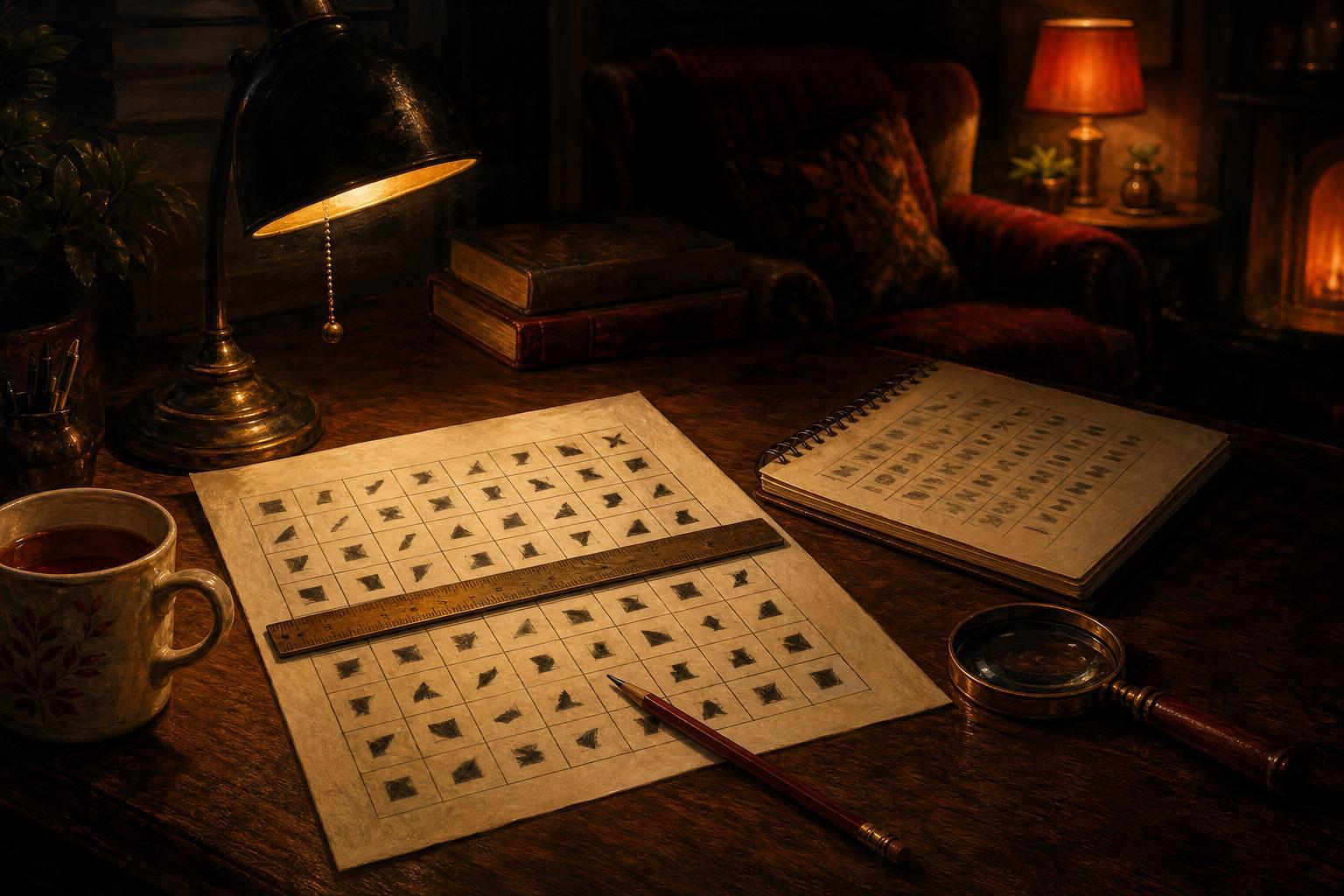
A number code replaces each letter with its place in the alphabet (A=1, B=2 and so on to Z=26), with dashes between letters and slashes between words.
It suits ages 6–8 and quietly practises counting and the alphabet. Write the A–Z key out on one line so children can refer to it.
A worked example: 8-5-12-12-15 spells HELLO.
Easy upgrades
- Start at a secret number: A=5, B=6, C=7 and so on.
- Count backwards: A=26, B=25, down to Z=1.
Either upgrade changes the code between messages, which makes it harder for a nosy sibling to crack.
The trade-off is that messages get long and fiddly. Keep first messages to three or four words.
What is the Caesar cipher and how do kids use it?
The Caesar cipher is a code where you shift every letter a set number of places along the alphabet, so with a shift of 3, A becomes D and HELLO becomes KHOOR.
It suits ages 9+, or younger children who enjoy puzzles and use a code wheel. The “key” is just the shift number, so the only thing to share is one digit.
A worked example with a shift of 1: BEWARE becomes CFXBSF.
It is named after Julius Caesar, who is said to have used a shift cipher to protect his messages.
Cracking it makes a good lesson on why a code is only as strong as its key. Try each shift from 1 to 25 until a real word appears. Our Caesar cipher guide shows the by-hand cracking method step by step.
How do you make a paper code wheel?
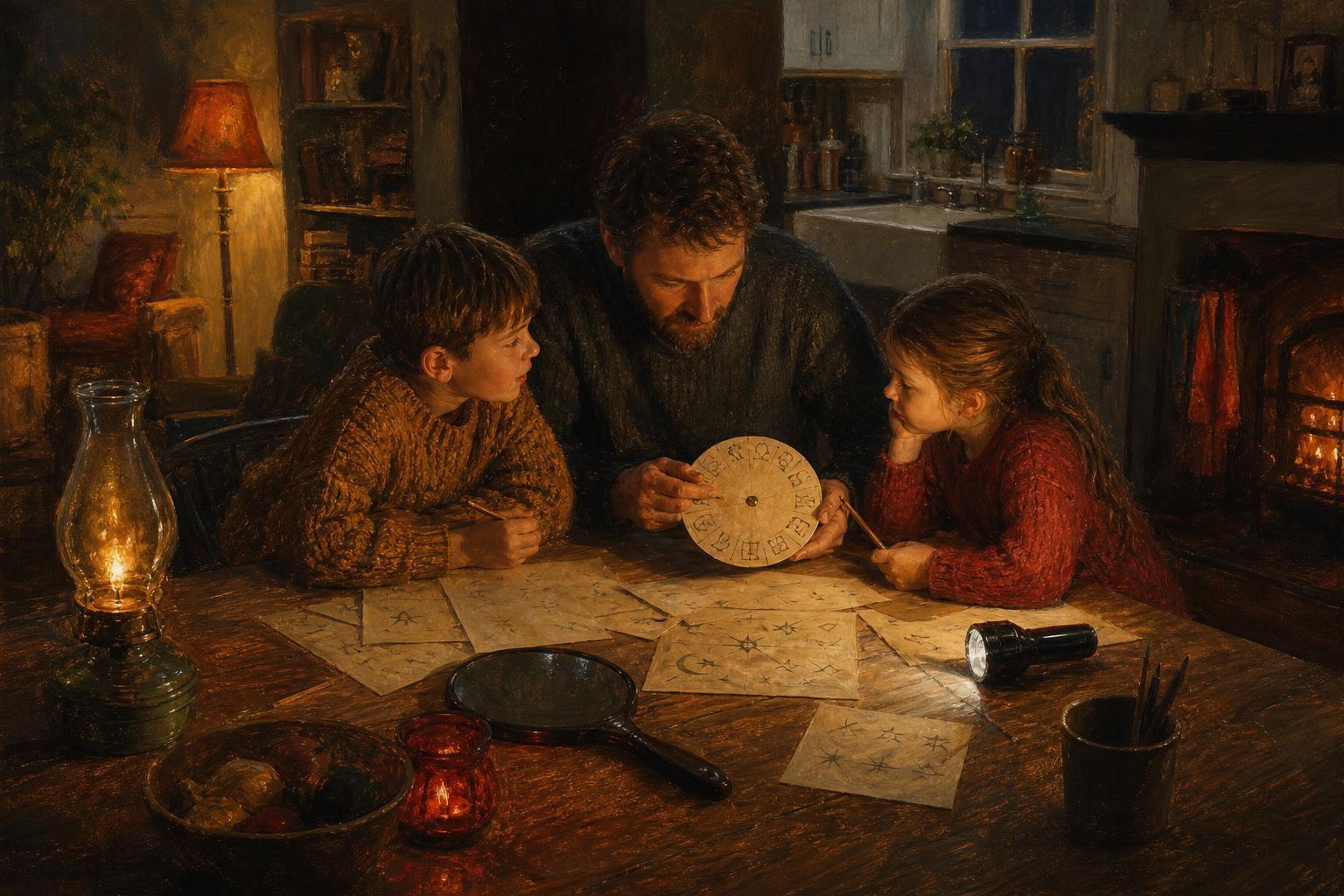
You make a paper code wheel by cutting two circles, writing the alphabet around the edge of each, and pinning the smaller one on top of the larger so you can turn it to set the shift.
Allow about 15 minutes, which makes it a good first half of a session.
- Trace round a saucer and a smaller bowl onto card or thick paper, then cut out both circles.
- Mark 26 equal sections on each circle. Fold the circle in half, then quarters, then use a ruler to space the rest, or pre-print a template.
- Write A to Z around the edge of each circle in the same order.
- Push a split pin (brass fastener) through the centres so the smaller circle sits on top and spins.
- Turn the inner circle so A lines up with the shift letter, then read across.
A worked example: set the inner A under the outer D for a shift of 3. Find each message letter on the outer ring and read the cipher letter beneath it on the inner ring.
Teachers can pre-print the alphabet rings so a class of 30 only needs to cut and pin. For younger children, an adult can cut the card and start the pin hole.
If you would rather skip the scissors, write A–Z twice on a strip of paper and slide a second strip along it.
How do the pigpen cipher and Morse code work for kids?
The pigpen cipher swaps each letter for a symbol based on the grid or X shape it sits in, while Morse code swaps each letter for a pattern of short and long signals (dots and dashes).
Pigpen (ages 8–10)
Draw two tic-tac-toe grids and two X shapes. Put A–I in the first grid, J–R in the second grid (each letter with a dot), then S–Z across the two Xs. Each letter’s symbol is the shape drawn around it.
Children love it because it looks like alien writing. Keep the key beside you for the first few messages, as it usually takes a few messages to remember. Our pigpen cipher guide with key and practice has the full layout.
Morse code (ages 9–12)
Each letter is a pattern of dots and dashes. E is one dot, T is one dash, S is three dots and O is three dashes. The famous SOS is three dots, three dashes, three dots.
You do not need equipment to play with it. Tap on a table, flash a torch or hum short and long notes.
The trade-off is memory. Give children a printed chart and keep their first words short. Our Morse code puzzles post has more ways to practise.
What is a simple code-breaking activity plan for kids?
A simple code-breaking session runs about 35 minutes: learn one code, write a message, swap with a partner, crack it, then try a final challenge.
- 5 minutes: teach the code. Show the key and read one example aloud together.
- 10 minutes: write. Each child writes a short message and a key note. Children aged 6–8 should use backwards writing or the number code.
- 5 minutes: swap. Pairs exchange messages but keep the key to themselves.
- 10 minutes: crack. Each child decodes the partner’s message, then they compare answers.
- 5 minutes: final reveal. Use the last message to point to a hidden treat or the next clue.
Keep first-round messages to three to six words so nobody gets stuck.
Extension and classroom variations
- For 9–12s: write three clue cards, each in a different code, leading to a small prize.
- In class: work in teams of three with a timer and a “cracker” badge for the first team to finish.
- Differentiation: give younger or slower writers a printed key, and challenge faster ones to crack a Caesar message by trying every shift.

Print-at-home case file
The Ashford Christmas Boxes — Free Print-at-Home Detective Case File
Free, short and screen-flexible, The Ashford Christmas Boxes is a good next step for families who enjoy the noticing and puzzling that codes teach, though it is a detective case rather than a codes workbook.
Get the caseWhat can kids try after they have mastered these codes?
Once children can write and crack all five codes, the next step is a longer mystery where codes are one clue among several, such as a short detective case file.
The Ashford Christmas Boxes is a free 30–45 minute mystery from Clues at Home, a UK studio that makes print-at-home detective case files. It is set on Christmas Eve, 1926, when the servants’ Christmas money vanishes from a locked library.
To be clear about the fit, it is a detective case rather than a codes workbook. It suits families who enjoy the investigating side, the noticing and the reasoning that codes train.
It is an instant PDF download that you can print or play from a tablet or laptop, and you get it free by joining the Clues at Home newsletter. When children want more ciphers, the codes and ciphers for beginners guide is the natural next stop.
Frequently asked questions
A cipher swaps or rearranges individual letters using a rule, such as shifting each letter along the alphabet. A code replaces whole words or phrases with other symbols or words. In everyday use people say "secret code" for both, and the kids’ codes in this article are technically ciphers.
Children can start around age 6 with backwards writing and the A=1 number code, as both need only spelling and counting. Ages 8–10 suit pigpen, and ages 9–12 suit the Caesar cipher and Morse code. A confident younger child can try harder codes with a printed key.
Change the key between messages, for example by starting the number code at a different letter or using a new Caesar shift each time. Avoid very short messages, and keep the key separate from the message. Backwards writing is easy to crack, so move on to Caesar or pigpen for real secrets.
Yes. Children can invent a symbol for each letter, swap letters in pairs, or add a twist to an existing code, such as counting backwards. The only rule is that they write the key down for their partner. Making a code is a good way to understand how cracking one works.
Try each shift from 1 to 25 until a real word appears. A paper code wheel makes this quick, because you only turn the inner circle one notch at a time. Short messages are the fastest to test, since you only need to read a few letters at each setting.
A white crayon on white paper, lemon juice that shows when warmed by an adult, tapping on a table in Morse code, or flashing a torch all work. Hand mirrors reveal mirror writing. Keep anything involving heat or a torch under adult supervision.
They give children practice with the alphabet, spelling, counting, patterns and careful checking, all disguised as a game. Cracking a code also teaches logical thinking, because you test a guess and revise it. Keep sessions short and fun so children stay keen.
Ready to play?
The Ashford Christmas Boxes — Free Print-at-Home Detective Case File
Free, short and screen-flexible, The Ashford Christmas Boxes is a good next step for families who enjoy the noticing and puzzling that codes teach, though it is a detective case rather than a codes workbook.
Get the caseBrowse every case in the Clues at Home shop: instant PDF downloads you can print and play tonight.