Last updated: November 2026
Most murder mystery games assume four to eight people, which leaves a couple, a parent and teenager, or two friends staring at a box that says “minimum four”. The good news is that 2-player detective games exist, and the best of them are not watered-down group games at all.
This guide covers the formats that genuinely work for two, how to score them, how to set up your table, and which Clues at Home case to start with. Clues at Home is a UK studio that makes print-at-home detective case files.
Quick answer
The best 2-player detective games are cooperative: you share the evidence and solve one case together. Print-at-home case files, two-player mystery board games and co-op puzzle games all work for a pair, because none needs hidden roles or a crowd. Case files such as The Thirty-Year Cask (2-4 players, about 1-2 hours) suit a night in.
Key takeaways
- Three formats work well for two: print-at-home case files, two-player mystery board games and co-op puzzle or escape-style games.
- With two players there is no bluffing crowd, so the fun comes from shared deduction over the same evidence.
- Co-op scoring is the safest default; a hybrid (together, then split) adds rivalry without a lopsided result.
- The Thirty-Year Cask is a Clues at Home case built for two, for 2-4 players and about 1-2 hours.
- A case file is a single-use story; if you want replays, a two-player board game is the better buy.
What are the best 2-player detective games?
The best 2-player detective games are the ones designed around shared deduction rather than hidden roles, which means case files, two-player mystery board games and co-op puzzle games.
A 2-player detective game is a mystery you solve by examining clues and reasoning towards a culprit, designed (or flexible enough) to work with exactly two people.
Two is a tricky number. Classic party murder mysteries rely on a roomful of suspects, bluffing and a bit of acting, so the format thins out badly when half the cast is missing.
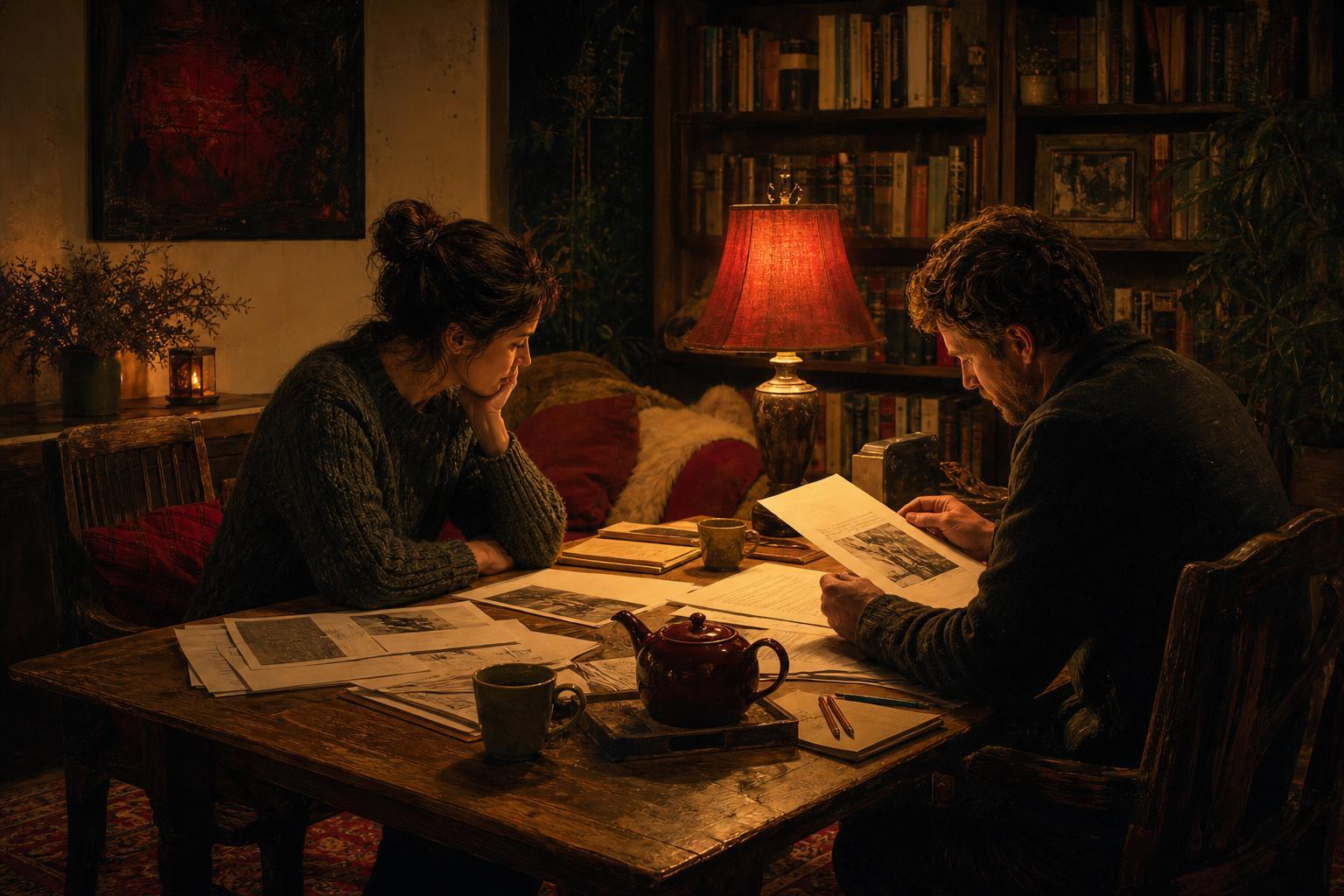
The formats below sidestep that problem. Nobody is hiding a secret role from you; you are both detectives, reading the same evidence and arguing over what it means. That argument is the pleasure.
If you are still deciding what a game needs in the way of numbers, our guide to how many players a murder mystery game needs covers the minimums in more detail.
Can you play a murder mystery game with just two people?
Yes, provided you pick a game built around investigation rather than roleplay, because case-file mysteries and co-op puzzle games do not need a table of suspects played by your friends.
The difference is simple. Party-kit games hand out character roles to guests, so each person plays a suspect. Case-file games make everyone a detective, and the suspects live on paper as profiles, statements and documents.
That means two players lose nothing structurally. You still get the full cast of suspects; you just meet them through evidence rather than across the dinner table.
What you do lose is a guest to be the unwitting culprit. That sounds like a drawback, but it makes the solve fairer: the answer has to come from the evidence, not from spotting who looks shifty.
One practical check before you buy: look for a stated player range that includes two. “Works with fewer if you improvise” is not the same thing. Our guide to choosing between a party kit or case file explains the split.
Which formats of 2-player detective game are there?
There are three main formats for two players: print-at-home case files, two-player mystery board games, and co-op puzzle or escape-style games, each with different strengths for a pair.
Print-at-home case files
A case file is a document-based investigation: evidence, suspect profiles and scored questions that you work through together. You read, discuss and deduce. Set-up is light, an evening is usually enough, and there is no board to store afterwards. You can read more in our explainer on print-at-home mystery games.
Two-player mystery board games
These use physical components and turn-taking. They suit people who like handling pieces and who want a game they can replay, since the board state changes each time. They sit on a shelf between sessions.
Co-op puzzle and escape-style games
These are puzzle chains rather than whodunits. If you and your partner would rather crack a lock, a code or a cipher than interrogate a suspect list, this is your format. A warm-up with codes and ciphers for beginners is a gentle way in.
The honest trade-off is replay value. Board games replay well; a case file is single-use, because once you know the solution the mystery is gone. We compare the two in more depth in print-at-home cases versus board game mysteries.
| Format | Best for | Replay value | Set-up effort | Typical session length |
|---|---|---|---|---|
| Print-at-home case file | Pairs who like reading, discussing and a story | Low: one solve per case | Low: print or open a PDF | Usually one evening |
| Two-player mystery board game | Pairs who like handling pieces and replays | High: can be played again | Medium: set out the board, learn the rules | Varies by game |
| Co-op puzzle or escape-style game | Pairs who prefer codes and locks to suspects | Low to medium | Low to medium | Varies by game |
These ranges are general. For a specific example, The Thirty-Year Cask is for 2-4 players and takes about 1-2 hours.
Should two players cooperate or compete in a detective game?
For most pairs, cooperating is more satisfying, but a light competitive scoring layer can add spice if you both enjoy a rivalry.
Co-op is the safe default. You pool your notes, agree one final answer and share the score. It suits couples, parent-and-teen pairs and anyone who dislikes there being a loser at the end of the night.
The competitive variant works the other way. Each of you keeps private notes and submits your own answers, then you compare scores. That only works if you are both confident and both honest about not peeking at the solution.
The hybrid is our favourite for two. Work together through the first phase, then split up and answer the scored questions separately. You get the shared thrill of the early deductions and a bit of friendly rivalry at the end.
| Scoring style | How it works for two | Best for | Watch out for |
|---|---|---|---|
| Fully cooperative | Shared notes, one agreed answer, one shared score | Couples, parent and teen, mixed experience | One player quietly doing all the thinking |
| Hybrid (together, then split) | Investigate together, then answer scored questions separately | Friends and confident couples | Agreeing in advance where “together” ends |
| Fully competitive | Private notes, separate answers, compare scores | Two evenly matched, trusting players | Lopsided results if experience differs; no reading ahead |
A simple house rule keeps either style honest: before naming a culprit, you must state means, motive and opportunity. Our guide to means, motive and opportunity explains each term.
How do you set up an incident room for two?
A two-person incident room is just a cleared table, a lit space and a shared place to put your evidence and notes, and it takes about ten minutes to set up.
- Clear a table big enough for two people to lay out documents side by side.
- Print the case, or open the PDF on a tablet or laptop.
- Put the evidence in a single pile and sort it by phase.
- Set up one shared notes sheet, plus a pencil each.
- Agree your scoring style (co-op, hybrid or competitive) before you start.
- Decide your pause points and when you will take a break.
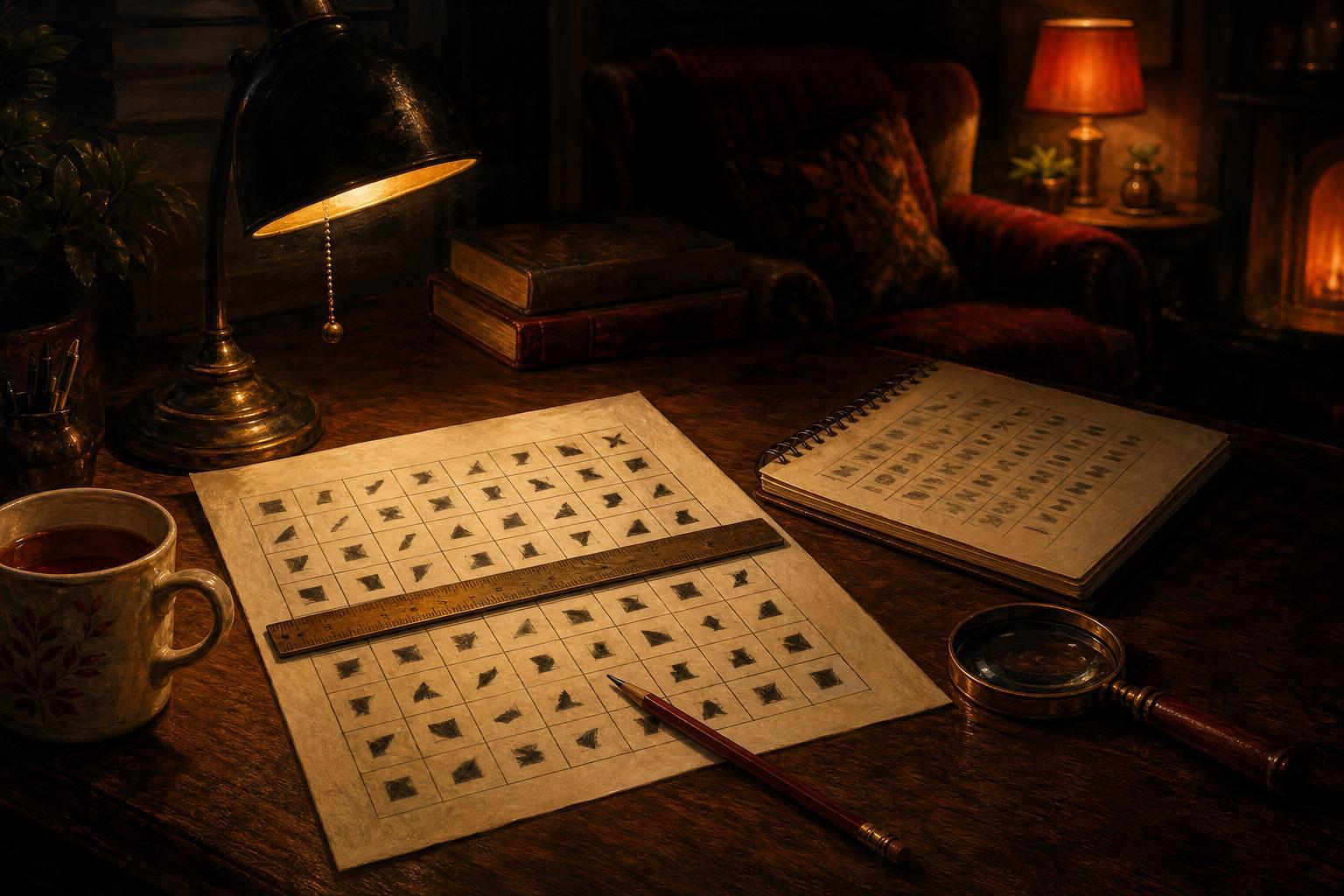
Atmosphere costs nothing. Use a lamp instead of the main light, make a pot of tea or open a bottle of wine, and put phones in another room.
Clues at Home cases are instant PDF downloads, so you can print them or play from a tablet or laptop. Printing suits couples who like spreading things out; a screen suits a sofa session.
One small tip: sit at right angles rather than opposite each other. You can both see the same page without reading it upside down.
If you want a fuller evening plan, with food and pacing, see our guide to how to run a date night mystery game at home.
Which Clues at Home case suits two players?
The Thirty-Year Cask is the clearest pick for two players: a print-at-home murder mystery for two, built for date night, set at a Highland whisky distillery.
The Thirty-Year Cask costs $12.99 and is for 2-4 players, with about 1-2 hours of play. The premise: a Highland whisky distillery, a thirty-year-old cask and a dinner that ends before dessert. It is an instant PDF download, so you can print it or play from a tablet or laptop.
It suits couples, and any pair who want a single-evening whodunit with an atmospheric setting. Because it is built for two, the structure does not lean on a crowd.
It does not suit everyone. If you want a replayable board game, or you would rather have something with no reading, look at the other formats above.

Print-at-home case file
The Thirty-Year Cask
A Highland whisky distillery, a thirty-year-old cask and a dinner that ends before dessert: The Thirty-Year Cask is built for two, so you get a full whodunit without needing a crowd.
Get the case — $12.99What other Clues at Home cases work for a pair?
Several other Clues at Home cases can be played by two people as co-operating detectives, though only some state a player range that includes two.
To be straight about it: The Thirty-Year Cask is the one with a stated 2-4 player range. For the others, check the case page before you buy.
- The Snowbound Manor Mystery is a 1920s Agatha Christie-style country-house whodunit, tagged for date night and solo puzzling. It suits a pair who want a classic.
- The Sealed Move is a chess murder mystery with real chess puzzles, and no chess experience is needed. It is a good pick for a chess-loving pair, or as a gift.
- The Ashford Advent is a 24-day advent mystery: an unsigned letter arrives each morning from 1 December, which makes it a shared daily ritual for a couple.
- The Ashford Christmas Boxes is a free 30-45 minute prequel to The Snowbound Manor Mystery, and a low-risk way to test the format.
| Case | Price | Format and length | Best for a pair who want |
|---|---|---|---|
| The Thirty-Year Cask | $12.99 | 2-4 players, about 1-2 hours | A one-evening date night whodunit |
| The Snowbound Manor Mystery | $12.99 | 1920s country-house whodunit | A classic Agatha Christie-style puzzle |
| The Sealed Move | $14.99 | Chess murder mystery with real chess puzzles | Something chess-flavoured, no experience needed |
| The Ashford Advent | $29.99 | 24-day advent mystery | A daily December ritual together |
| The Ashford Christmas Boxes | Free | 30-45 minute case | A free trial of the format |
If you are unsure whether case files are for you, start with the free one. Our roundup of free printable mystery games lists more ways to try before you spend anything.
Are 2-player detective games good for parent-and-teen pairs and friends?
Yes, a shared-deduction mystery is one of the easier ways to get a teenager and a parent at the same table, because it gives you both a puzzle to argue over rather than each other.
Parent and teen
Choose a setting your teenager finds interesting, and keep it co-op so nobody gets beaten by a parent. Letting the teen run the notes sheet gives them ownership of the investigation.
Check age suitability on the case page before buying, as ratings vary by case. Several of our cases are written with adults in mind, so they may not suit younger teens. Younger children are better served by a different format altogether.
Two friends
The hybrid scoring style works well here. Investigate together, answer separately, and put bragging rights on the line.
For wider screen-free options beyond detective games, see our list of family games to play at home.
How do you choose between a case file and a board game for two?
Choose a case file if you want one self-contained evening of story and deduction, and a two-player board game if you want something you can replay and keep on a shelf.
- Pick a case file if you like reading, discussing and a fresh story each time.
- Pick a board game if you like handling pieces and playing again and again.
- Pick a co-op puzzle game if you prefer codes and locks to characters.
On cost, a case file is a single purchase for a single solve, while a board game spreads its cost across many plays. On time, a case file is an evening: The Thirty-Year Cask runs about 1-2 hours, while board game sessions vary by game.
The honest caveat is this: if you want a replayable game for two, a board game is the better buy. A case file is for a new story every time you play.
For a wider comparison across formats, read our guide to the best detective games to play at home.
Frequently asked questions
Yes. The Thirty-Year Cask is a print-at-home murder mystery built for two and for date night, with a stated range of 2-4 players and about 1-2 hours of play. You investigate together as detectives, reading the same evidence, so nothing depends on extra guests.
You can do either. Clues at Home cases are instant PDF downloads, so you can print them at home or play from a tablet or laptop. Printing suits pairs who like spreading evidence across a table; a screen suits a sofa session.
It varies by format and game. Case files are typically a single evening; The Thirty-Year Cask takes about 1-2 hours. Board games and co-op puzzle games vary widely, so check the box or product page. Build in a break if you want to stretch it over a longer night.
Yes. The Ashford Christmas Boxes is a free 30-45 minute print-at-home case from Clues at Home, available by joining the newsletter. It is a prequel to The Snowbound Manor Mystery and a low-risk way for two people to test the format before buying a full case.
Play it cooperatively and share the jobs. Let the weaker puzzler keep the notes sheet and read evidence aloud, while the other proposes theories. Avoid fully competitive scoring, which can feel lopsided when experience differs. A hybrid style also works if you agree the rules first.
Case files cannot, really: once you know the solution, the mystery is gone. Each case is a one-off story. If replay value matters most, a two-player mystery board game is a better fit. You could also give a finished case to friends who have not played it.
Very little: a cleared table, good light, a pencil each and one shared notes sheet. Add tea, wine or snacks if you like, and keep phones elsewhere. If you are playing from a tablet or laptop, you only need the device and something to write on.
Ready to play?
The Thirty-Year Cask
A Highland whisky distillery, a thirty-year-old cask and a dinner that ends before dessert: The Thirty-Year Cask is built for two, so you get a full whodunit without needing a crowd.
Get the case — $12.99Browse every case in the Clues at Home shop: instant PDF downloads you can print and play tonight.